On The Future of Architecture Since 1889

Click to see more photos of the work
Tatu Tuominen has cut up the image-text narrative of a history of modernist architecture, creating collages that filter into and merge with frames reminiscent of window blinds. The distinction between motif and ground, theme and support, becomes dissolved.
Tuominen’s works examine modernist architecture, community planning and lifestyle in the form of monuments, retroactive assemblages, labyrinthine collages merging into the support. The interrogated archive is text and images in
J.-L. Cohen’s The Future of Architecture Since 1889. The wrought-iron Eiffel Tower and the never-built monument to the Third International are edited into a diaphanous superimposition that hints at the collapse of belief in modern technological progress and of social and political utopias.
In Paris, Capital of the Nineteenth Century, Walter Benjamin wrote about glass-and-iron architecture as a metaphor of the modern age. The combination signalled the advent of the steel construction in architecture. Such structures were initially hidden inside the façades of historicist revival styles, such as neo-classicism, used typically in transport stations and shopping arcades. Architectural uses of glass, too, were initially strictly utopian, and it was not until the 1920s, in the wake of functionalism, that glass-and-steel architecture was adopted more broadly in construction. According to Benjamin, this delay made the substructure a kind of unconscious. Glass architecture was seen as a culmination of a process of evolution in which the tectonic structure would become completely transparent unto itself. Technological progress was also emblematic of social progress – only a social revolution would liberate tectonics to its ultimate, undistorted brilliance. According to Benjamin, this would take place in the forthcoming egalitarian, classless society.
In Tatu Tuominen’s works, the idea of modernist progress, the transparency of the glass-iron structure, has transformed into steel-plexiglas bars and designed surfaces into collision walls or leaking sieves of image and text. In his piece On The Future of Architecture Since 1889 (Modernization), a spread from the architectural volume becomes the backside of a wooden frame, closed like a gate by the hanging wire. The works recall riot fences and other embodiments of the bounded, controlled public space. The inspiration behind On The Future of Architecture Since 1889 (Black Steel) is an image of a steel structure, an experimental multipurpose space designed by a progressive French architectural group in the 1930s. The sepia-tinted print squeezes the motif onto the support, turning it into an armoured endpoint, a terminus emptied of all function.
The work deconstructs the projections of modern spatiality (life form) and temporality (purposeful utopia).
Inkamaija Iitiä – Future Archives, 2018

——————————————————————————————————————-
A Near Approach to Immortality (Foliage)
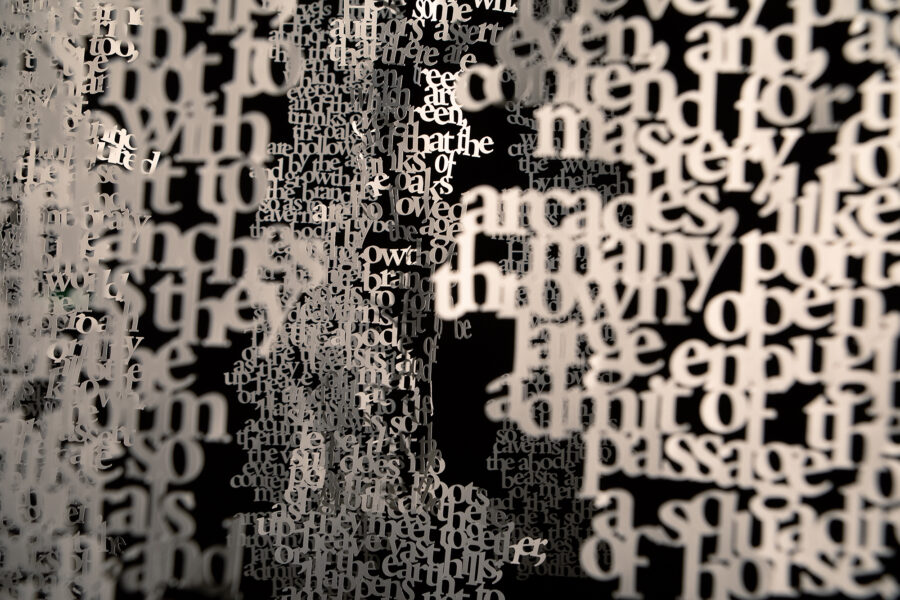
Click to see more photos
A Near Approach to Immortality (Foliage) is a paper cut-out installation comprised of letters. Tuominen cut out the parts of Pliny the Elder’s Naturalis Historia that dealt with the Hercynian Forest and created an installation in the gallery – a kind of foliage made up of quotations from natural history texts.
Pliny refers to the Hercynian Forest twice in his work Naturalis Historia. Hercynia is a mythical primeval forest that was situated beyond the borders of the Roman Empire, in the region of western Central Europe. According to Pliny, Hercynia is an impenetrable and otherworldly place. To him, it represents untamed nature—a territory that not even Rome could govern. Pliny writes: “the Hercynian Forest, whose gigantic oaks, uninjured by the lapse of ages, and contemporary with the creation of the world, by their near approach to immortality surpass all other marvels known. It is startling that something which, in its own time, seemed as if it had always existed and would exist forever, has disappeared and remains only in stories.
By examining, appropriating, and transforming printed images and texts from the archives of various museums, with a view to their continued — and often overlooked — import on the present, Tuominen generates new knowledge and connections between different documents, themes, periods, as well as histories, places, and subjects. He sees the media he uses in his artistic process as open systems through which time can be reconfigured: pasts can be reconstructed, possible futures imagined, and reflections made on what might be recovered from what has been lost.