A Near Approach to Immortality
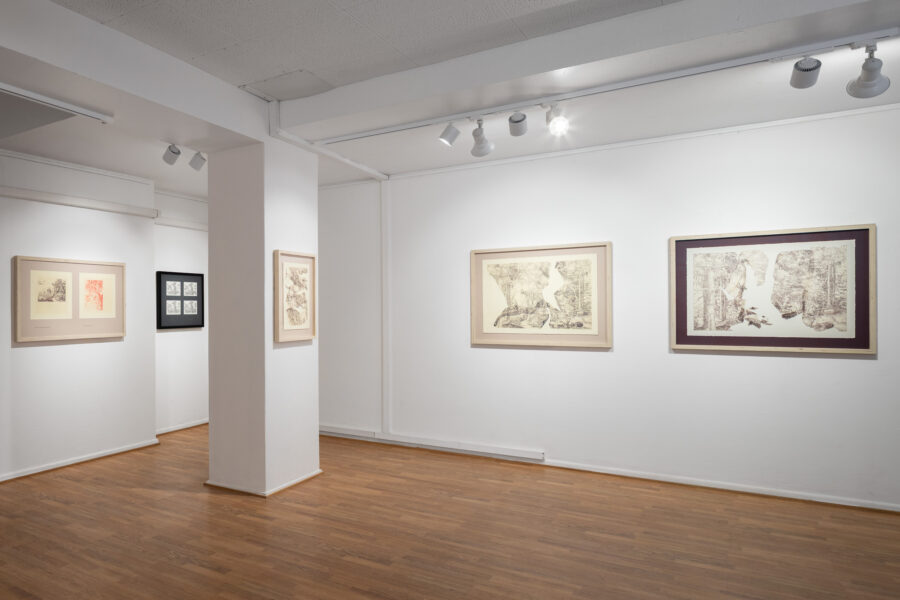
A Near Approach to Immortality (Landscapes) is a series of drawings that explores the lost European primeval forest through historical renaissance landscape etchings of the German painter and printmaker Albrecht Altdorfer (1480–1538).
Tatu Tuominen creates new landscapes by tracing the lines of Altforfer’s etchings, manipulating them through drawing, cutting and gluing paper. He sees this process as John Berger understands drawing in “Tense: Conditional” (Landscapes: John Berger on Art, 2016). By drawing in this way, we can construct an alternative world – a vision of what would be if… This allows us to bring back what has once disappeared. With this series of drawings, Tuominen presents a world that could exist if the human need to clear forests for agriculture and produce timber on an industrial scale had not led to the destruction of almost all old-growth forests.
An art-historical landscape — be it based on perception or imagined — has often been presented as perfect, static, and complete. In the current ecological situation, however, proposing this kind of landscape seems impossible. The landscape no longer presents itself as pristine or permanent, because human activity has an impact everywhere in the world. This is why the landscape drawings are in a state of becoming: they are imperfect, in flux, and fragmentary — as is the world around us.
By examining, appropriating, and transforming printed images and texts from the archives of various museums, with a view to their continued — and often overlooked — import on the present, Tuominen generates new knowledge and connections between different documents, themes, periods, as well as histories, places, and subjects. He sees the media he uses in his artistic process as open systems through which time can be reconfigured: pasts can be reconstructed, possible futures imagined, and reflections made on what might be recovered from what has been lost.