TATU TUOMINEN: A Near Approach to Immortality
13.2–8.3.2026
Galleria Katariina, Rikhardinkatu 1, Helsinki
ti-pe 11–17
la-su 12–16
(in English below)
”Maisema… on suuri… salaisuus… Tosiasiassa… se syntyy… katsojan… silmissä” (Olga Tokarczuk, Empusion, s. 93, suom. Tapani Kärkkäinen)
Tatu Tuomisen näyttely A Near Approach to Immortality on teoskokonaisuus, joka käsittelee kadonnutta eurooppalaista aarniometsää. Sitä tarkastellaan historiallisten dokumenttien välityksellä: antiikin ajan ensyklopediatekstin ja renessanssin ajan maisemaetsauksien kautta. Näyttelyn teokset tutkivat, mitä taidehistorialliset kuvat kertovat ihmisten suhteesta metsään ennen ja nyt.
Taidehistoriassa maisema – olkoon se havaintoon perustuva tai kuviteltu – on usein esitetty täydellisenä, staattisena ja valmiina. Nykyisessä ekologisessa tilanteessa tällaisen maiseman esittäminen tuntuu kuitenkin mahdottomalta. Maisema ei enää näyttäydy koskemattomana tai pysyvänä, sillä ihmisen toiminta on muuttanut jokaisen maailman kolkan. Siksi Tatu Tuomisen esittämät maisemateokset ovat tekeytymisen tilassa: ne ovat epätäydellisiä, muutoksessa, fragmentaarisia – niin kuin maailma ympärillämme on.
Näyttelyyn Tuominen ammentaa pääasiassa kahdesta historiallisesta lähteestä: roomalaisen kirjailijan ja luonnonhistorioitsijan Plinius vanhemman (23–79 jaa.) kirjoituksista sekä saksalaisen taidemaalarin ja -graafikon Albrecht Altdorferin (1480–1538) maisemaetsauksista.
Plinius vanhempi mainitsee kahdesti teoksessaan Naturalis Historia Hercynian metsän. Hercynia oli myyttinen aarniometsä, joka sijoittui Rooman valtakunnan rajojen ulkopuolelle, läntisen Keski-Euroopan alueelle. Tässä metsässä aluskasvustona on kerros mytologisia ja kulttuurisia merkityksiä. Pliniuksen mukaan Hercynia on läpitunkematon ja sadunomainen paikka. Se edustaa hänelle villiä luontoa – aluetta, jota edes Rooma ei voinut hallita. Plinius kirjoittaa: ”[…]Hercynian metsän valtavat tammet, joita aikojen kulku ei ole vahingoittanut ja jotka ovat syntyneet yhtä aikaa maailman kanssa, lähestyvät kuolemattomuutta ja ylittävät kaikki muut tunnetut ihmeet […]” On pysäyttävää, että jokin, joka omana aikanaan on vaikuttanut olleen olemassa aina ja tulevan olemaan ikuisesti, on kadonnut ja jäänyt elämään vain kertomuksina.
Näyttelyn toinen lähde, Altdorferin maisemaetsaukset, tekivät vaikutuksen Tuomiseen hänen nähdessään ne Staatliche Museen zu Berlinin kokoelmissa. Altdorferin grafiikansarjat olivat ensimmäisiä teoksia, joiden avulla maiseman käsite tuli tunnetuksi Euroopassa, sillä niitä pystyttiin – toisin kuin aikalaismaalauksia – monistamaan ja levittämään useina vedoksina. Tämä tapahtui 1500-luvun ensimmäisinä vuosikymmeninä, samaan aikaan maiseman noustessa kuvataiteessa ensi kertaa itsenäiseksi aiheeksi, ilman ihmishahmoja sekä ilman uskonnollista tai mytologista alatekstiä.
Teossarjasssa A Near Approach to Immortality (Landscapes) Tuominen luo uusia maisemia etsausten viivoja toisintamalla, muokkaamalla niitä piirtäen sekä papereita leikkaamalla ja liimaamalla. Hän ajattelee maisemien tekemistä John Bergerin tavoin ”Tense: Conditional” (Landscapes: John Berger on Art, s. 24), piirtämisenä konditionaalissa: Tällä tavoin piirtämällä voimme kuvitella vaihtoehtoisen, eräänlaisen Mitä jos -maailman, joka mahdollistaa myös kerran hävinneen takaisin tuomisen. Piirustussarjassaan Tuominen esittelee maailman, joka voisi olla olemassa, jos ihmisen tarve tuottaa puutavaraa teollisella mittakaavalla ei olisi hävittänyt lähes kaikkia luonnonvaraisia metsiämme.
Näyttelyssä esillä oleva toinen teos, A Near Approach to Immortality (Hercynian Forest) on liikkuvan kuvan ja äänen teos, jossa Hercynian metsä nousee paperisena lavasteena katseen liikkuessa hitaasti maisemassa. Teoksessa pieni paperisilppu kasvaa elokuvallisiin, kolossaalisiin mittasuhteisiin. Teoksen ääniraita on koostettu paperista lähtevistä äänistä.
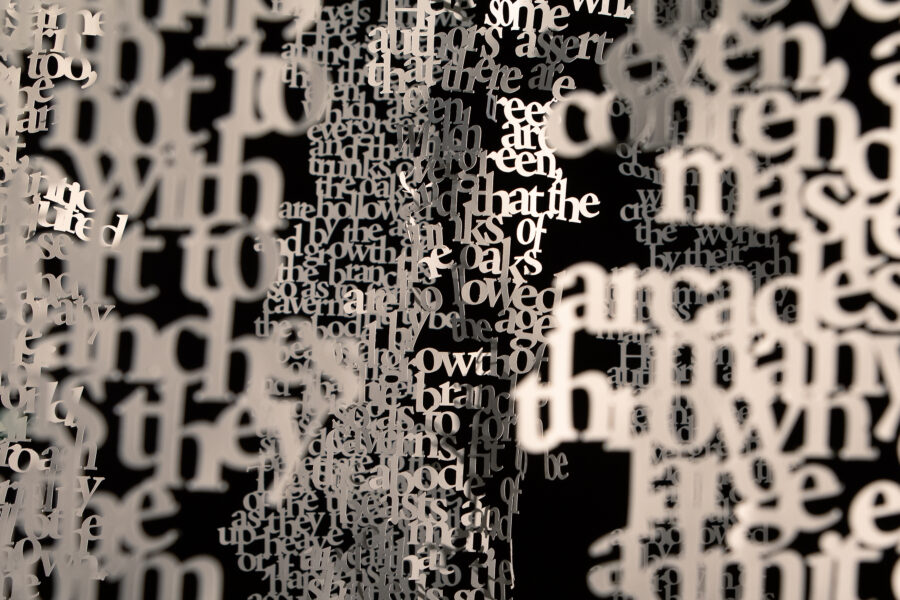
Kolmas teos A Near Approach to Immortality (Foliage) on kirjaimista koostuva paperileikkausinstallaatio. Tuominen leikkasi paperista Plinius vanhemman teoksesta Hercynian metsää käsittelevät kohdat* ja rakensi galleriatilaan installaation, eräänlaisen luonnonhistorian sitaateista koostuvan lehvästön.
Altdorferin ja Plinius vanhemman kuvaamat metsämaisemat ovat hävinneet Keski-Euroopasta metsäkadon seurauksena aikaa sitten. Jo antiikin aikana heräsi huoli metsien katoamisesta ja silloinkin kysyttiin, missä määrin luonnon muokkaaminen on oikeutettua. Tämä pohdinta jatkuu yhä – alati voimistuvan ympäristökatastrofin keskellä. Näyttelyn taidetokset kysyvät: Mikä on historiallisten maisemakuvien suhde tämän päivän luontokeskusteluun? Voisiko kadonneen muisteleminen saada meidät kuvittelemaan toisenlaisen tulevaisuuden ympäristöllemme?
Tutkimalla, lainaamalla ja muuntamalla eri museoiden arkistoissa olevia painettuja kuvia ja tekstejä, tunnistaen niiden jatkuvan – usein huomiotta jäävän – vaikutuksen nykyhetkeen, Tuominen tuottaa uutta tietoa ja luo yhteyksiä eri dokumenttien, teemojen, aikakausien sekä historioiden, paikkojen ja toimijoiden välille. Hän näkee käyttämänsä mediumit avoimina järjestelminä, joiden kautta aikaa voidaan käsitellä vapaasti: rekonstruoida menneisyyksiä, kuvitella mahdollisia tulevaisuuksia ja pohtia, mitä kadonneesta voisi tuoda takaisin.
Ekologisen kriisin aiheuttaman tuhon laajuutta on vaikea käsittää, sillä sitä on vaikea hahmottaa ihmiselämän aikana. Laajentamalla perspektiiviä satoihin vuosiin saatamme ymmärtää paremmin, kuinka valtava muutos on ja mitä kaikkea olemme menettäneet. Emme voi enää palata vuosisatoja sitten kadonneisiin aarniometsiin, mutta tämä näyttely voi auttaa kuvittelemaan miltä tuntuu kävellä niiden siimeksessä.
* Plinius vanhempi. Naturalis Historia, perinteisesti ajoitettu noin vuosille 77–79 jaa.
Sitaatit ovat Philemon Hollandin englanninkielisestä käännöksestä The Historie of the World (Lontoo, 1601).
“In the same northern regions, too, is the Hercynian Forest, whose gigantic oaks, uninjured by the lapse of ages, and contemporary with the creation of the world, by their near approach to immortality surpass all other marvels known. Here some authors assert that there are even trees which are evergreen, and that the trunks of the oaks are hollowed by the age and growth of the branches so as to form caverns fit to be the abode of beasts and of men; and that their shade is so dense that the sun does not penetrate to the ground.”
“That the roots of the trees there, as they meet together, up-heave vast hills; or, if the earth happens not to accumulate with them, rise aloft to the very branches even, and, as they contend for the mastery, form arcades, like so many portals thrown open, and large enough to admit of the passage of a squadron of horse.”
Taiteilijan työskentelyä ja teosten toteuttamista ovat tukeneet Suomen Kulttuurirahasto, Taiteen edistämiskeskus ja AVEK.

“Landscape… is a great… secret… In fact… it takes shape… in the eyes of the beholder.” (Olga Tokarczuk, The Empusium: A Health Resort Horror Story, translated by the artist)
Tatu Tuominen’s exhibition A Near Approach to Immortality is a body of work that explores the lost European premeval forest. It is examined through historical documents: Encyclopedic text from classical antiquity and renaissance landscape etchings. The artworks of the exhibition probe what art-historical images reveal about the human relationship with the forest, both in the past and in the present.
An art-historical landscape—be it based on perception or imagined—has often been presented as perfect, static, and complete. In the current ecological situation, however, proposing this kind of landscape seems impossible. The landscape no longer presents itself as pristine or permanent, because human activity has an impact everywhere in the world. This is why the landscape works presented by Tatu Tuominen are in a state of becoming: they are imperfect, in flux, and fragmentary—as is the world around us.
For the exhibition, Tuominen draws primarily on two historical sources: the writings of Roman author and natural historian Pliny the Elder (23–79 CE) and the landscape etchings of the German painter and printmaker Albrecht Altdorfer (1480–1538).
Pliny the Elder refers to the Hercynian Forest twice in his work Naturalis Historia. Hercynia is a mythical primeval forest that was situated beyond the borders of the Roman Empire, in the region of western Central Europe. In this forest, the undergrowth is layered with mythological and cultural meanings. According to Pliny, Hercynia is an impenetrable and otherworldly place. To him it represents untamed nature—a territory that not even Rome could govern. Pliny writes: “[…] the Hercynian Forest, whose gigantic oaks, uninjured by the lapse of ages, and contemporary with the creation of the world, by their near approach to immortality surpass all other marvels known. […]”. It is startling that something which, in its own time, seemed as if it had always existed and would exist forever, has disappeared, and remains only in stories.
The exhibition’s second source, Altdorfer’s landscape etchings, made a strong impression on Tuominen when he first saw them in the collections of the Staatliche Museen zu Berlin. Altforfer’s print editions were among the first works to disseminate the concept of landscape across Europe, as they could—unlike contemporary paintings—be reproduced in multiple copies and distributed. This coincided, during the first decades of the 16th century, with the emergence of landscape as an independent subject-matter in visual art, for the first time without humans and without a religious or mythological subtext.
For the series A Near Approach to Immortality (Landscapes), Tuominen creates new landscapes by tracing the lines of Altforfer’s etchings, manipulating them through drawing, cutting and gluing paper. He sees this process as John Berger understands drawing in “Tense: Conditional” (Landscapes: John Berger on Art, 2016). By drawing in this way, we can construct an alternative world–a vision of what would be if… This allows us to bring back what has once disappeared. With this series of drawings, Tuominen presents a world that could exist if the human need to clear forests for agriculture and produce timber on an industrial scale had not led to the destruction of almost all old-growth forests.
The second work on display, A Near Approach to Immortality (Hercynian Forest), is a moving image and sound work in which the Hercynian forest emerges as a paper stage set, while the viewer’s gaze slowly moves through the landscape. In the work, the small paper scraps grow to colossal, cinematic proportions. The soundtrack is composed of sounds produced by the paper itself.
The third work, A Near Approach to Immortality (Foliage) is a paper cut-out installation comprised of letters. Tuominen cut out the parts of Pliny’s text that dealt with the Hercynian Forest* and created an installation in the gallery–a kind of foliage made up of natural history quotes.
The forest landscapes depicted by Altdorfer and Pliny the Elder have long since disappeared from Central Europe due to deforestation. Concern over the loss of forests emerged already in antiquity, and even then, there was a debate about the extent to which human intervention in nature is justified. This discussion continues today—during an ever-intensifying ecological catastrophe. The artworks in the exhibition engage with this debate by questioning: What is the relationship between historical landscape images and today’s environmental discourse? Could the act of remembering help us imagine a different future for our environment?
By examining, appropriating, and transforming printed images and texts from the archives of various museums, with a view to their continued—and often overlooked—import on the present, Tuominen generates new knowledge and connections between different documents, themes, periods, as well as histories, places, and subjects. He sees the media he uses in his artistic process as open systems through which time can be reconfigured: pasts can be reconstructed, possible futures imagined, and reflections made on what might be recovered from what has been lost.
The scale of devastation wrought by the ecological crisis is hard to comprehend, as it cannot be fully understood within a single lifetime. But by broadening the perspective into hundreds of years, we can better understand the magnitude of this change and what it is that we have lost. We can no longer return to the primeval forests that vanished centuries ago, but in this exhibition, one can imagine what it might feel like to walk under their canopy.
* Pliny the Elder. Naturalis Historia, traditionally dated to c. 77–79 CE.
Quotations from the English translation by Philemon Holland, The Historie of the World (London, 1601).
“In the same northern regions, too, is the Hercynian Forest, whose gigantic oaks, uninjured by the lapse of ages, and contemporary with the creation of the world, by their near approach to immortality surpass all other marvels known. Here some authors assert that there are even trees which are evergreen, and that the trunks of the oaks are hollowed by the age and growth of the branches so as to form caverns fit to be the abode of beasts and of men; and that their shade is so dense that the sun does not penetrate to the ground.”
“That the roots of the trees there, as they meet together, up-heave vast hills; or, if the earth happens not to accumulate with them, rise aloft to the very branches even, and, as they contend for the mastery, form arcades, like so many portals thrown open, and large enough to admit of the passage of a squadron of horse.”
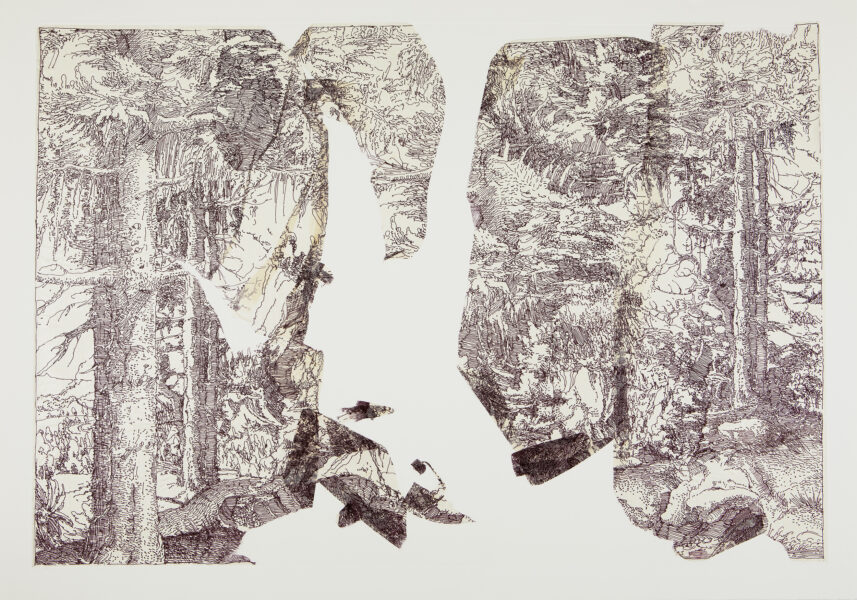
drawing and chine-collé, Photo: Tatu Tuominen, 2026